 musopana
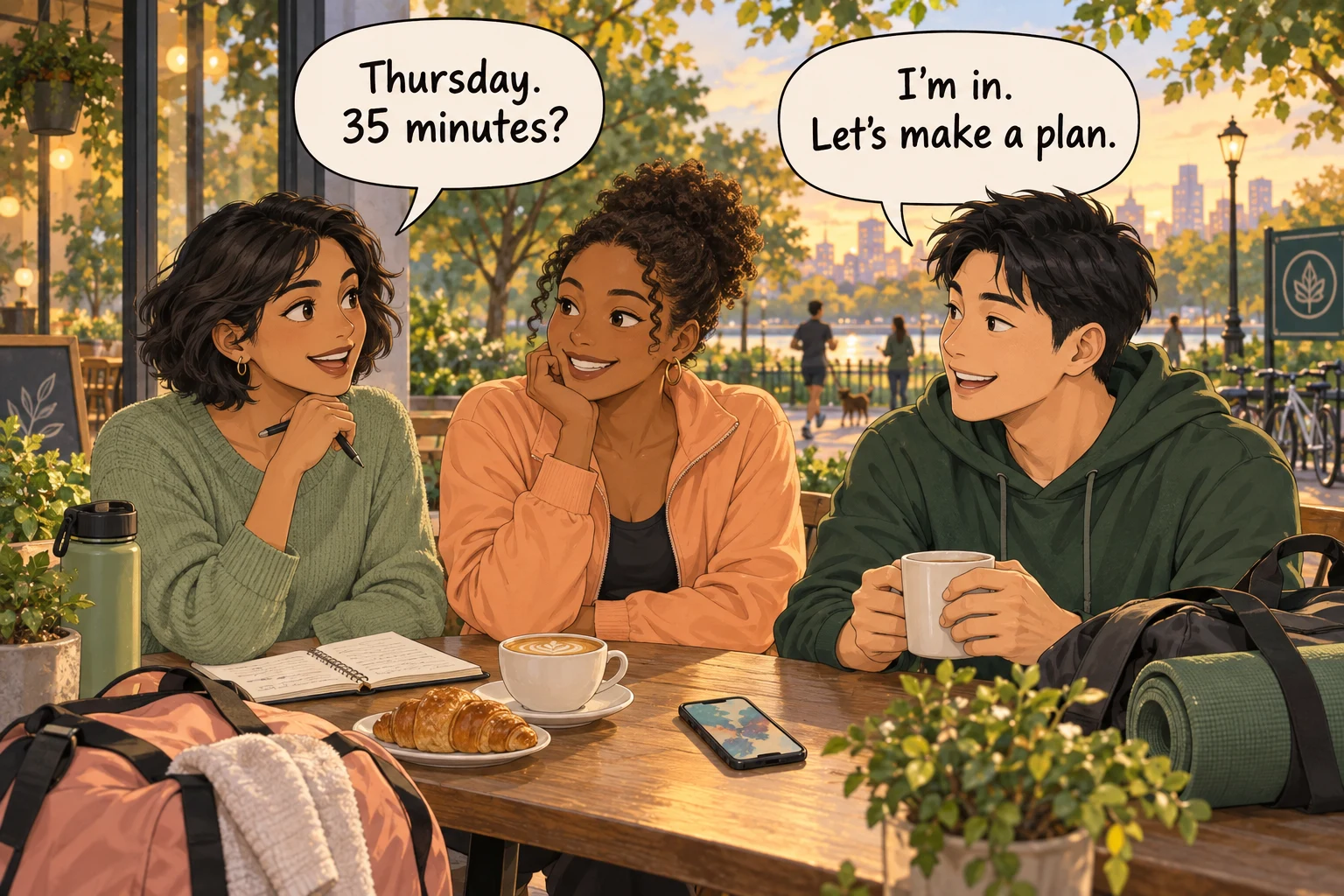
You and a friend agree that you should exercise together. A few messages follow. Tuesday might work. Someone suggests the weekend. By the time the conversation ends, you have agreed on the importance of exercise without agreeing on a workout.
Now imagine a more specific exchange: Thursday, thirty-five minutes, a session you have both reviewed and accepted. You still have to show up. But there is much less left to negotiate when Thursday arrives.
That is the possibility behind planning with friends. Another person can make an intention more concrete. A little competition may add energy. The useful question is what these arrangements actually change: attendance, daily activity, the ability to keep going—or the speed at which someone reaches a health goal.
The research is more convincing about the first three than the last. It gives us reasons to design for shared commitment, without promising that a group chat or leaderboard will make everyone healthier faster.
What changes when other people are involved?
In the BE FIT trial, Mitesh Patel and colleagues studied 200 adults from 94 families. Everyone tracked steps, set a goal and received individual feedback. One group also took part in a family game designed around shared accountability. Over twelve weeks, participants in the game reached their step goals on 53% of participant-days, compared with 32% in the control group: an observed difference of 21 percentage points. The adjusted improvement in daily steps was 953 steps greater than control, with a 95% confidence interval of 505–1,401.1
This comparison matters because both groups already had family connections. It tested a structured activity programme involving those connections, not the difference between having friends and having none. The researchers measured walking, not how quickly people achieved a broad definition of health.1
The STEP UP trial tested different social arrangements in 602 adults with overweight or obesity. Against a tracker-and-goal control, additional daily steps were greatest in the competition arm; support and collaboration also helped.2

The competition and collaboration groups generally comprised people who did not previously know one another. This is evidence about social design, not specifically about competing with close friends. Competition had the largest estimate, but the direct differences among the three game arms were not statistically significant. All three arms combined social features with other game elements.2
An older study offers a more direct look at arriving with people you know. Rena Wing and Robert Jeffery recruited 166 adults either alone or with three friends or relatives. Among participants recruited alone into standard behavioural treatment, 76% completed treatment and 24% fully maintained their weight loss between months four and ten. For those recruited with friends and given additional social-support strategies, the figures were 95% and 66%.3
Those are striking differences, but the comparison bundles recruitment with a support intervention. People were not randomly assigned to arrive with friends. It is a useful finding about participation and maintenance, not a clean estimate of friendship’s effect or a promise of faster weight loss.3
Friendly competition needs a purpose
In an eleven-week university exercise programme, Jingwen Zhang and colleagues randomly assigned 790 students to different online social arrangements. Attendance was 90% higher in the two conditions containing social comparison, pooled together, than in the two without it. The supportive condition alone did not outperform control. These were constructed peer networks with incentives, not established friendship groups.4
The implication is more interesting than “competition wins.” People need something useful to respond to. Encouragement, a visible commitment and comparison with peers are different experiences; putting them all under a “social” label hides the design choices.
There is counterevidence too. In the Columbia Moves pilot, 116 adults entered as 24 teams with existing social ties. Adding competition and challenges to a technology-supported programme did not produce a statistically significant improvement in independently measured daily steps at twelve weeks. The adjusted difference was −425 steps/day, with a confidence interval spanning −1,065 to +215. A favourable Fitbit difference was also not significant in adjusted analyses.5
We should therefore resist drawing a single “with friends versus alone” growth curve. These studies test different programmes and outcomes. None establishes how many weeks a Musopana user could save on a personal health goal. For product design, our interpretation is narrower: make it easier to agree on a manageable session, retain individual choice, and evaluate whether people actually return.
What we’re building into Friends
We’re building Friends around two ways of making fitness more social: planning workouts together and competing with people you know. The aim is to give a shared intention somewhere to go, whether your group wants company for a session or a little friendly rivalry over time.
The planning foundation already includes private gym teams. People connect by exact username, accept a friend request and join an invited team. A shared proposal specifies participants, a workout focus and a time window. Each person reviews the agreement before activation.
The shared part is the exercise plan and commitment. Individual prescriptions, weights, health information and workout results remain personal. A team does not become a public view into someone’s health history.
Update, September 29, 2026: private friends and team planning are in the beta. Competition among friends remains a preview of what we’re building. These examples illustrate the intended experience, not customer results or an announcement of general availability. The planning scenarios reflect the current implementation; the competition example describes a possible design whose scoring and rules are still to be confirmed.
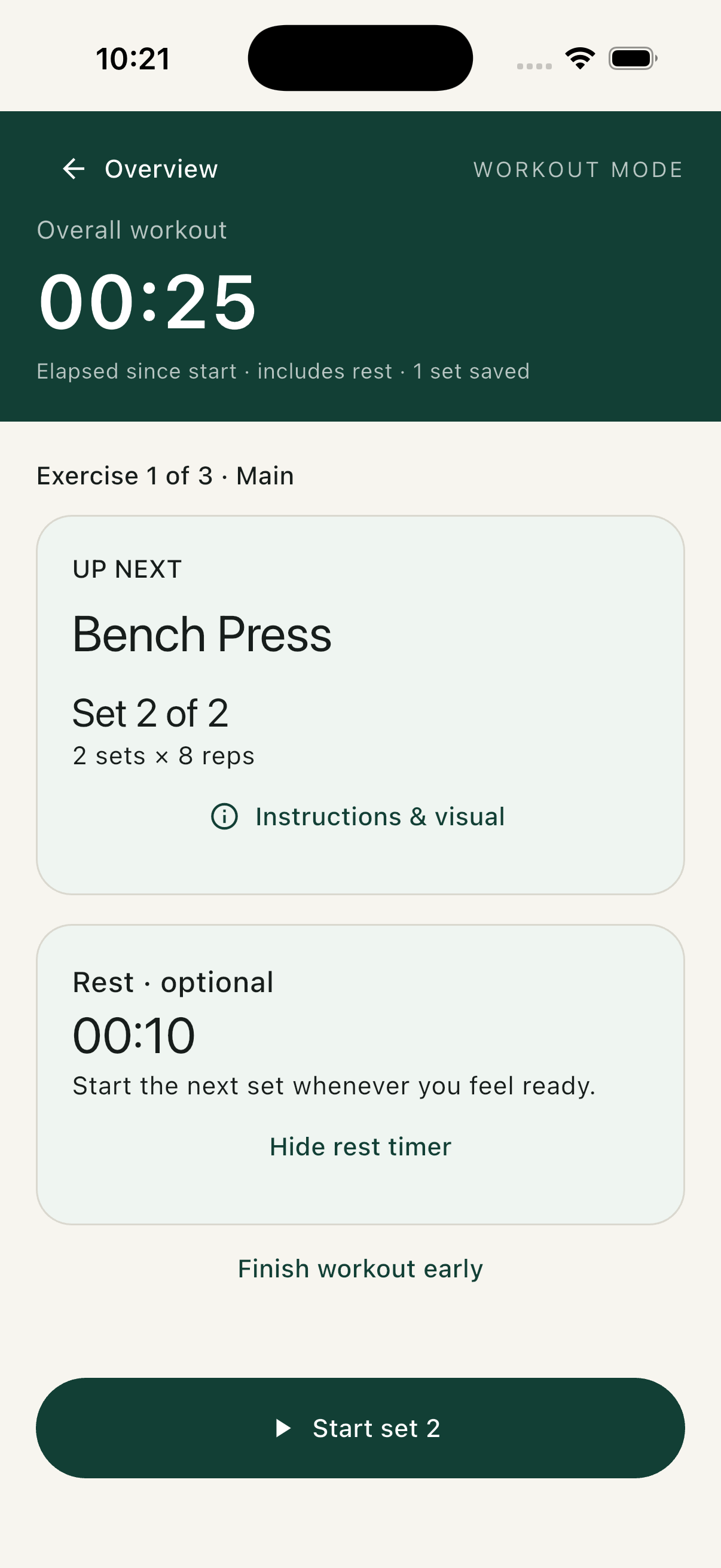
Two friends, different starting points. Maya and Dev want to train together, but they do not use the same weights. They prepare a session from the workout days available to them and review the shared exercises. Each follows their own personal prescription. The point of meeting is to do a session together; neither has to match the other’s load for it to count.
A group turns “sometime” into an agreement. Three teammates choose a prepared workout day, a focus and a thirty-five-minute window. Each reviews and agrees to the proposal. If the time, exercises or personal prescriptions change, everyone must agree again. An accepted plan should mean the same thing to everyone taking part.
A shared session fits an existing routine. One friend already has an individual workout planned. Before accepting the team session, they see how it would replace or move that workout. The app asks for confirmation; it does not silently add a second workout. If they prefer to keep the individual plan, they can decline the shared one.
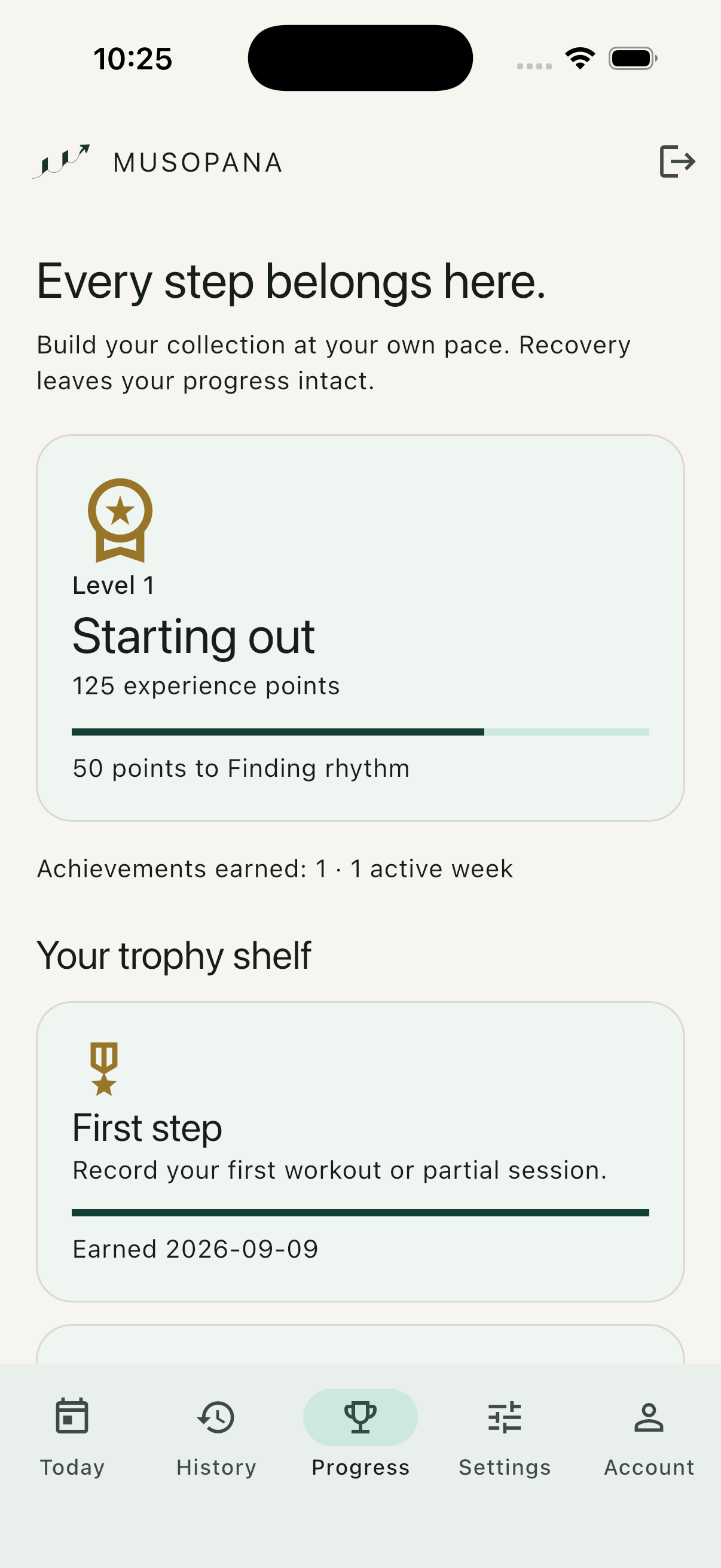
Friends turn consistency into a friendly contest. Imagine Maya and Dev agreeing on a short challenge around completing the sessions they each planned. They can compete without needing identical weights, schedules or starting points. One possible approach would compare progress against each person’s own agreed commitment, rather than simply reward whoever does the most. This is an illustration of the competition direction, not a confirmed scoring formula.
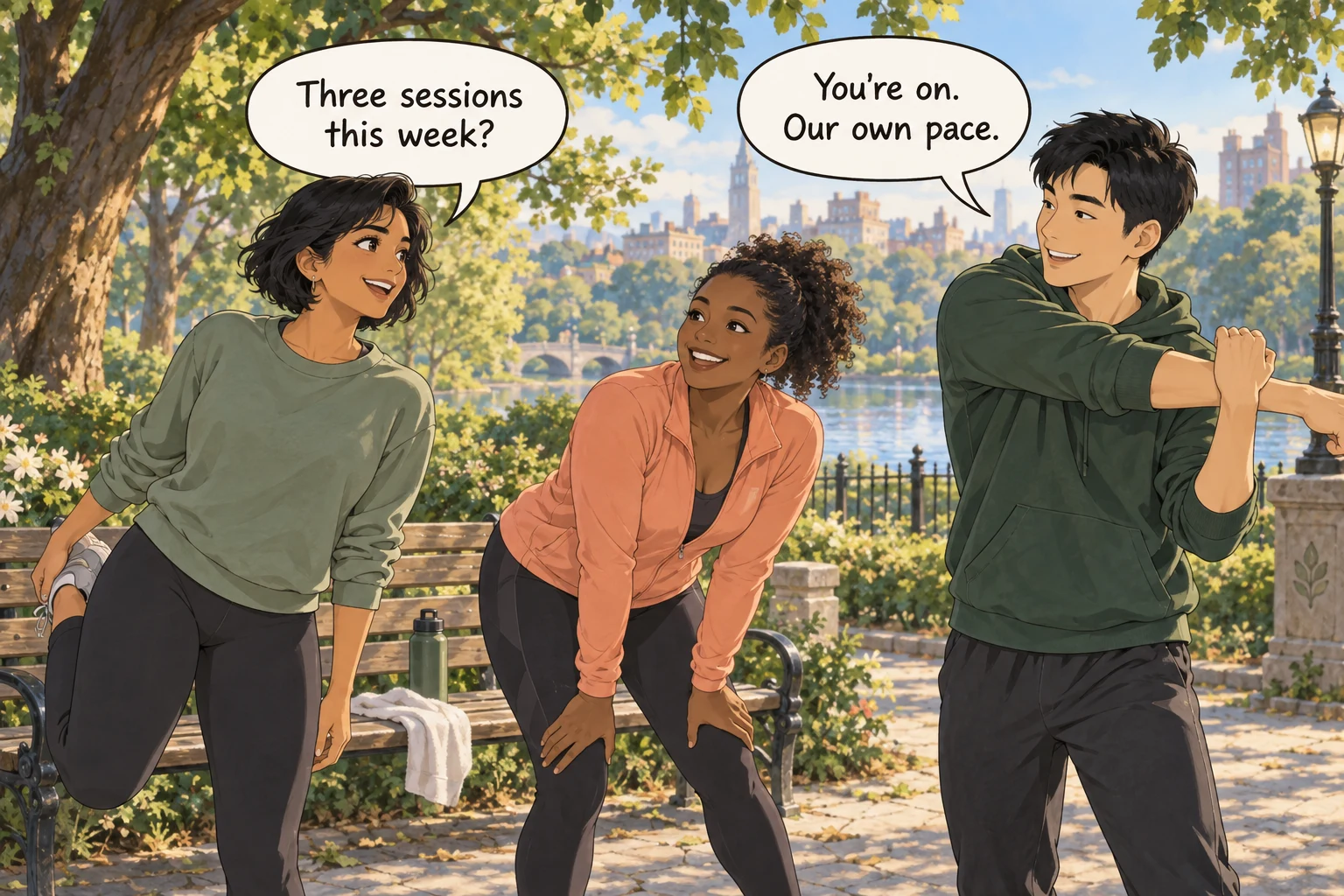
That distinction matters to the experience we want to build. A competition can be exciting without treating the strongest or most available person as the only one making progress. We still need to settle the rules: what counts, what friends can see, and how a changed plan or missed session affects a challenge. The research gives us reasons to explore competition; it does not tell us that any leaderboard we build will work.
The ambition is tangible: help friends turn an intention into a shared plan, and give those who enjoy competition another reason to keep coming back. The outcome worth earning is a routine that lasts beyond the first burst of enthusiasm.
References
- Patel MS, Benjamin EJ, Volpp KG, et al. Effect of a Game-Based Intervention Designed to Enhance Social Incentives to Increase Physical Activity Among Families: The BE FIT Randomized Clinical Trial. JAMA Internal Medicine. 2017;177(11):1586–1593. doi:10.1001/jamainternmed.2017.3458. ↩
- Patel MS, Small DS, Harrison JD, et al. Effectiveness of Behaviorally Designed Gamification Interventions With Social Incentives for Increasing Physical Activity Among Overweight and Obese Adults Across the United States: The STEP UP Randomized Clinical Trial. JAMA Internal Medicine. 2019;179(12):1624–1632. doi:10.1001/jamainternmed.2019.3505. ↩
- Wing RR, Jeffery RW. Benefits of recruiting participants with friends and increasing social support for weight loss and maintenance. Journal of Consulting and Clinical Psychology. 1999;67(1):132–138. Original abstract and bibliographic record. ↩
- Zhang J, Brackbill D, Yang S, Becker J, Herbert N, Centola D. Support or competition? How online social networks increase physical activity: A randomized controlled trial. Preventive Medicine Reports. 2016;4:453–458. doi:10.1016/j.pmedr.2016.08.008. Author repository. ↩
- Monroe CM, Cai B, Edney S, et al. Harnessing technology and gamification to increase adult physical activity: a cluster randomized controlled trial of the Columbia Moves pilot. International Journal of Behavioral Nutrition and Physical Activity. 2023;20:129. doi:10.1186/s12966-023-01530-1. ↩