 musopana
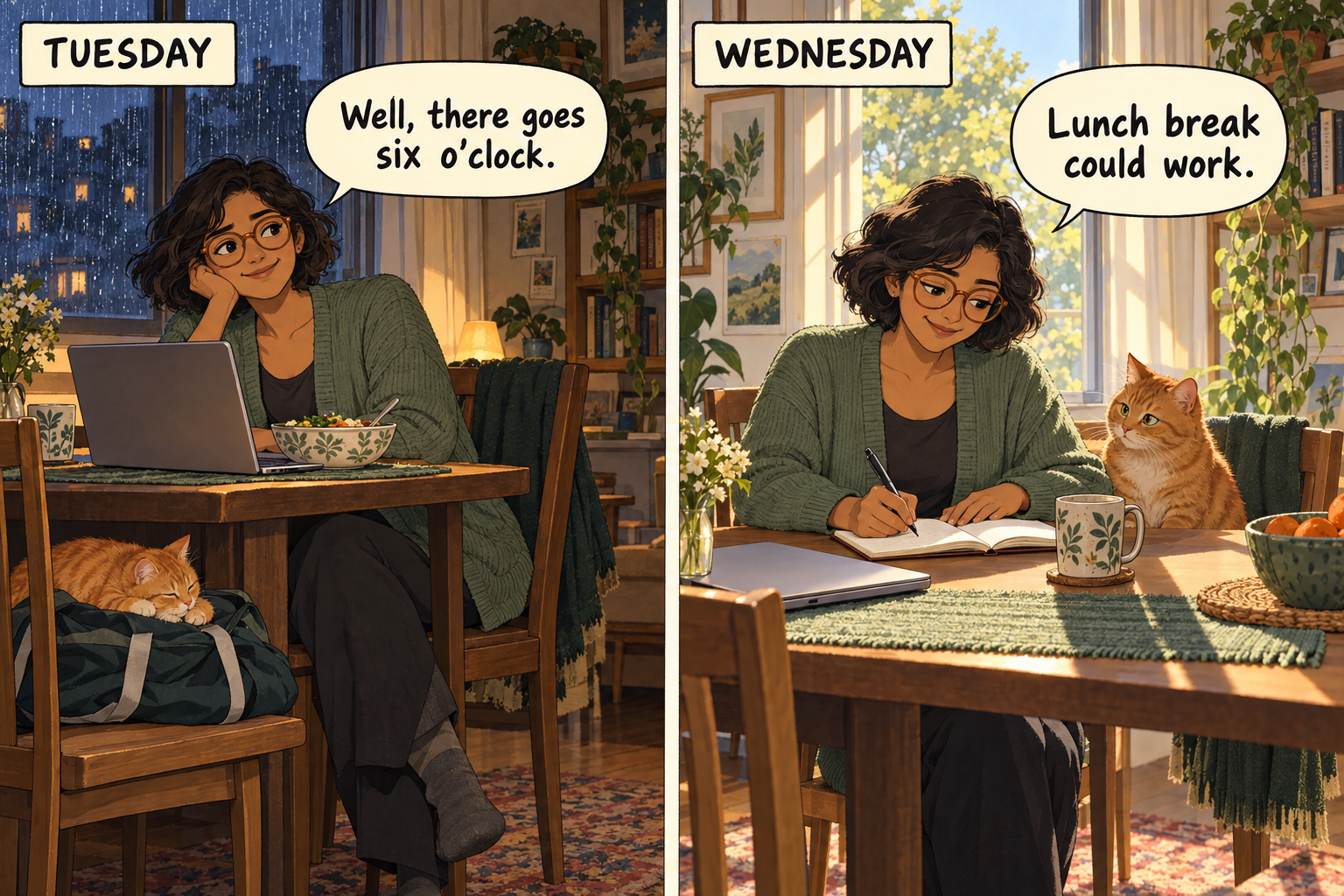
Maya’s gym bag has been beside the door since breakfast. At five, the evening still looks straightforward: finish work, change, leave at six. At half past six, she is answering one last question on a call. At seven, she is deciding what to make for dinner.
The bag stays where it is. The cat has found it useful.
On Wednesday morning, the practical problem is small but irritating. Does she move yesterday’s workout? Leave it and do the next one? Wait until Monday, when the week will look tidy again?
Maya didn’t need another reason to exercise on Tuesday. She needed a plan that still made sense on Wednesday.
A familiar time can help. What happens when you miss it?
There is a good reason to choose a regular time for something you want to repeat. In a study of 96 volunteers, Phillippa Lally and colleagues asked people to repeat an eating, drinking or activity behaviour in the same context for twelve weeks. Participants recorded the behaviour and how automatic it felt. Repetition in a consistent context was associated with increasing automaticity.1
But a familiar cue and an unmovable appointment are different things.
John Beshears and colleagues tested that distinction in a field experiment involving exercise incentives. Some participants were paid for visiting the gym within a planned daily two-hour window. Others could earn a reward for attending at any time of day. The flexible arrangement generated more gym visits, both during the intervention and after the rewards stopped. Even in subgroups induced to exercise at similar rates during the intervention, the fixed-window group showed a larger subsequent decline.2
This was a study of rewarded gym attendance, not a test of whether everyone should abandon a regular exercise time. It suggests a question worth asking of a routine: if the usual opportunity disappears, is there another acceptable way to carry on?
Maya likes evening workouts. She doesn’t need to stop liking them. This Wednesday, though, she has a clear lunch break. She chooses a session that fits it and puts her bag beside her work chair, where even the cat will have trouble hiding it.
Wednesday isn’t starting from zero
Another finding from Lally’s study is relevant here: missing a single opportunity did not materially affect the habit-formation process. That is a narrower claim than “breaks don’t matter.” The study measured self-reported automaticity across several kinds of behaviour; it did not establish what extended inactivity does to strength, endurance or health.1
For Maya, it is a reason to treat Tuesday as one missed occasion. The earlier sessions still happened. Wednesday does not need to become a punishment for the evening she lost.
This distinction also matters in an app. A record can accurately show an unfinished or missed workout without presenting the rest of someone’s effort as erased. Keeping a history honest means preserving both the work and the gaps.
By lunchtime, Maya has twenty minutes she can use. There isn’t time for the longer session she originally imagined, but there is time to do something.
The World Health Organization’s guidance recognises that some physical activity is better than none and that activity comes from more than formal workouts: walking, cycling, household tasks and recreation all contribute. That does not make a short walk interchangeable with a strength session, or guarantee that a shortened workout meets a particular training goal. It does give us a reason to avoid treating every smaller opportunity as worthless.3
Maya finishes what she chose for Wednesday. The rest of the afternoon is still full. Nothing has become effortless; she has simply found a workable place for exercise in it.
Some days need a different decision
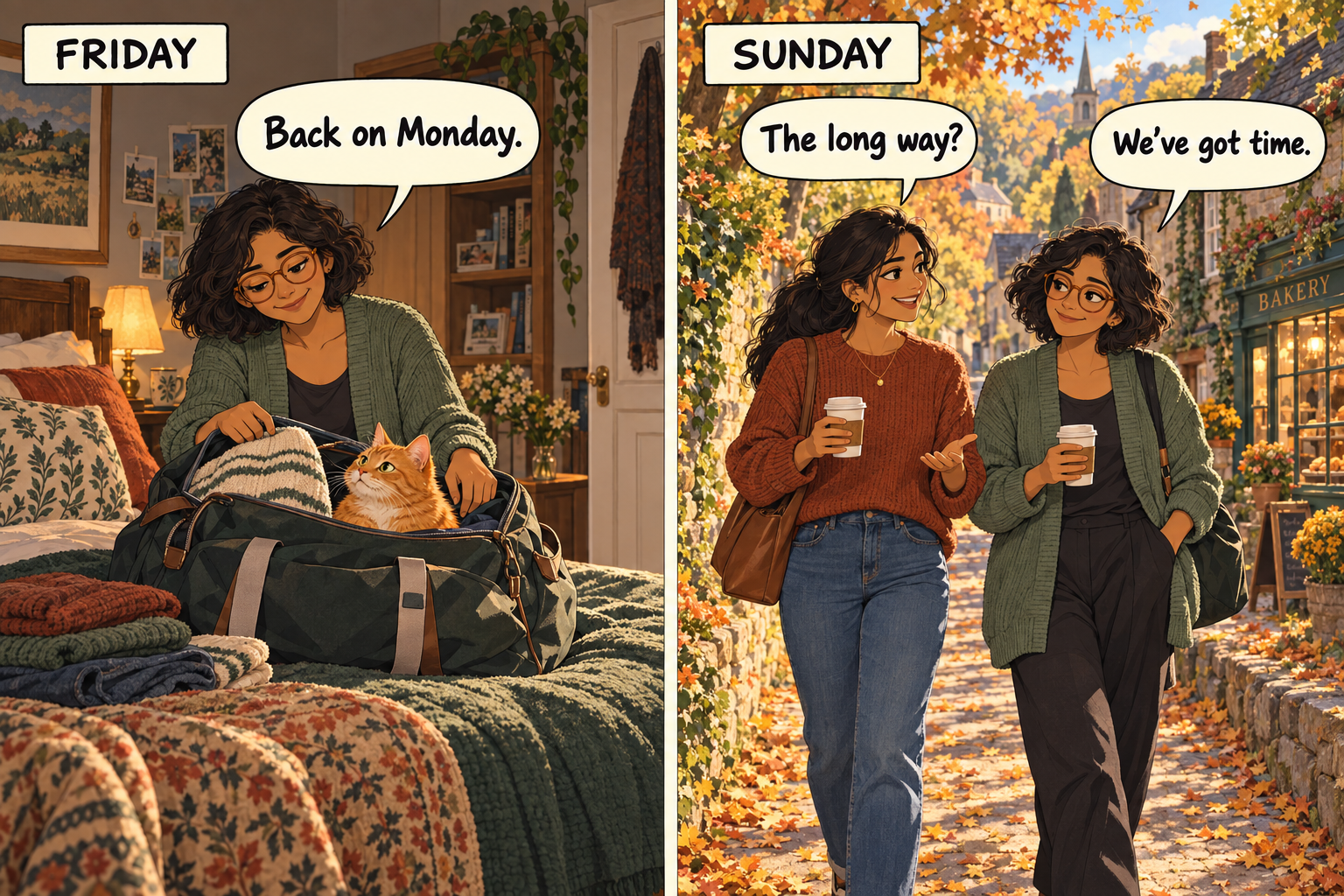
On Friday, she packs for a weekend with family. She knows there will be train journeys, a crowded spare room and very little control over the timetable. She decides to pause her planned training until she is home.
A deliberate pause is useful information. It means something different from forgetting a session, and something different again from completing one. A calendar should be able to express that without turning the break into imaginary exercise credit.
On Sunday, Maya goes for a walk with her sister. They take the long way to the bakery because the weather is good. Neither calls it a replacement workout. It is an enjoyable part of the day.
What this asks of Musopana
These are the situations behind our recent work on scheduling, training pauses and saved workouts. A useful plan has to deal with the time someone actually has, including the occasions when there is no suitable slot.
Musopana’s planning work respects preferred windows and available time, with explicit controls to defer, skip or pause. A time someone chose or edited themselves deserves protection. If the day has no room, the answer should be visible rather than a booking squeezed into an unsuitable gap.
Pause and resume are part of that same idea. Your history stays intact, and paused dates do not count as completed workouts. Returning should reconnect someone with their record, without requiring them to pretend the break never happened.
Friday’s break. Monday’s next step.
For Maya’s weekend away, the route starts in Settings → Pause training. Pausing stops workout planning and automatic calendar bookings. Paused days neither break nor increase the training streak, and history stays unchanged.
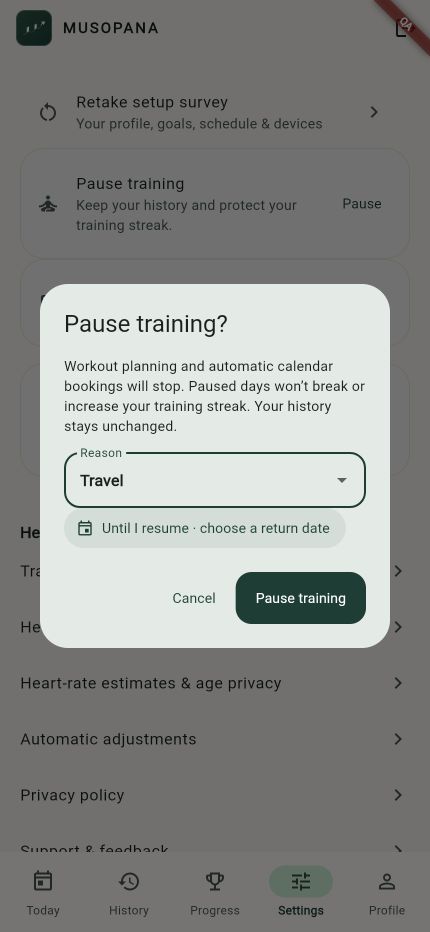
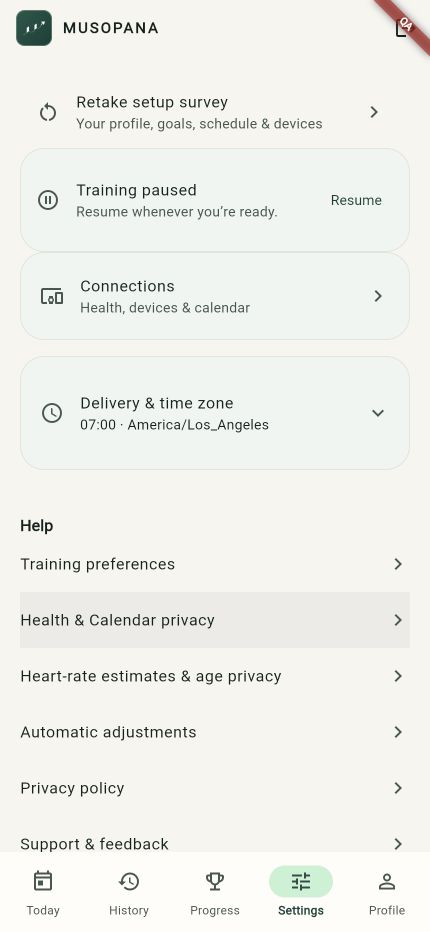
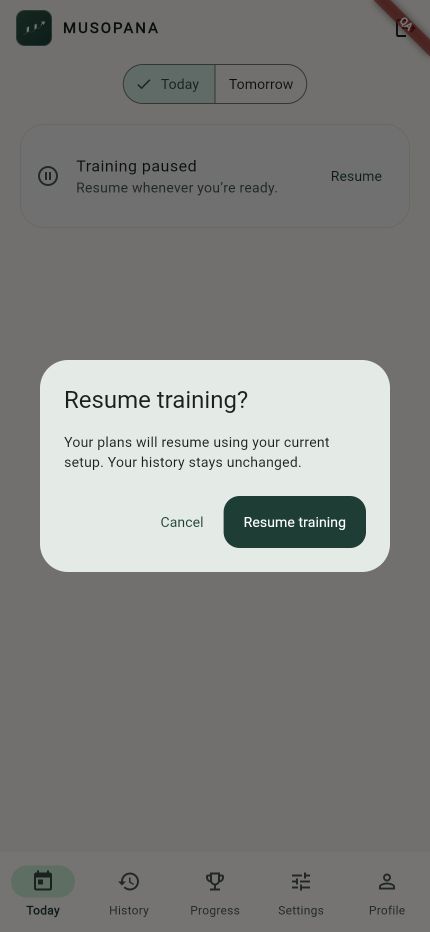
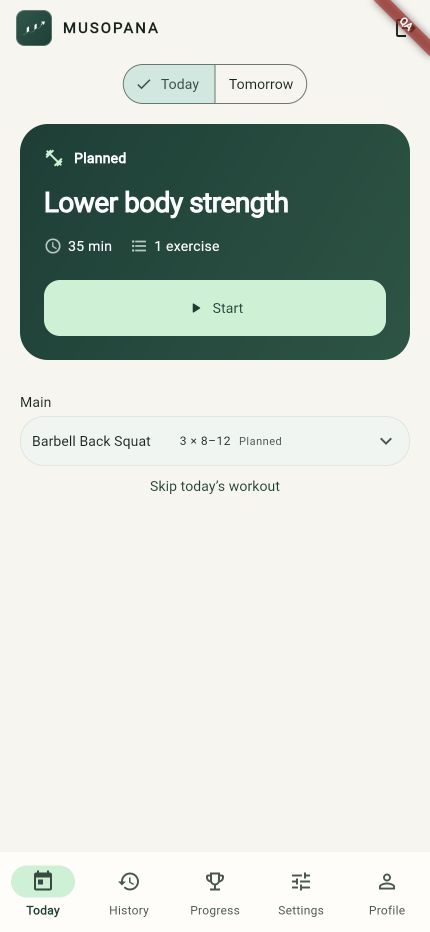
Screens captured from the current Flutter app in a local browser preview, using a synthetic account and simulated responses for pause and resume. The app screens are unaltered; the QA ribbon identifies the preview. This illustrates the flow, not a production account or a claim that every beta build includes it.
We have also been working on opening saved workouts and recording sets locally, so a lost connection need not become another reason to abandon a session. The saved work can upload when connectivity returns. The workout needs to have been saved while you were online.
We’re building towards this experience across the beta, so availability will depend on your version. Automatic scheduling needs the relevant permissions and an opportunity for the app to run. The research helps explain why we care about these situations; whether our approach helps people keep exercising is something we still have to establish.
On Monday, Maya unpacks the bag and puts it by the door again. She has a time in mind. If the day changes, she will need another decision.
That is a moment a health app can earn its place: when someone opens it after a gap and wants to know what to do next.
References
- Lally P, van Jaarsveld CHM, Potts HWW, Wardle J. How are habits formed: Modelling habit formation in the real world. European Journal of Social Psychology. 2010;40(6):998–1009. doi:10.1002/ejsp.674. ↩
- Beshears J, Lee HN, Milkman KL, Mislavsky R, Wisdom J. Creating Exercise Habits Using Incentives: The Trade-off Between Flexibility and Routinization. Management Science. 2021;67(7). Published online 2020. doi:10.1287/mnsc.2020.3706. Abstract and bibliographic record. ↩
- World Health Organization. Physical activity. Fact sheet. Read source. Accessed 7 October 2026. ↩