 musopana

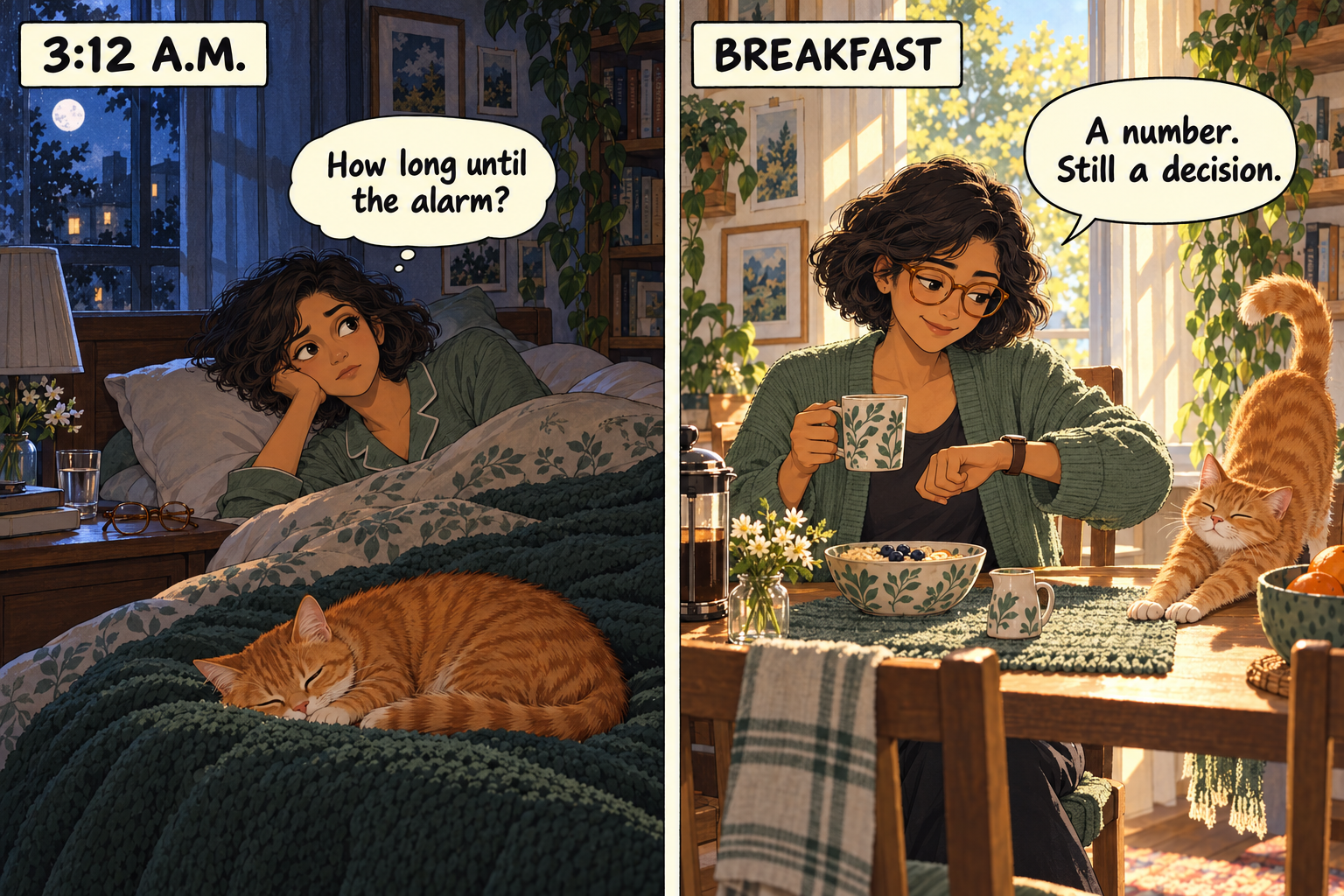
At 3:12 a.m., Maya is awake. Nothing dramatic has happened. She went to bed late, woke up thirsty, and made the mistake of checking the time. Now she is calculating how much sleep she could still get.
By breakfast, her watch has supplied its own assessment.
Her workout is less concerned. It contains the same exercises and sets she looked at yesterday.
She has time to train. She even wants to. But she feels tired, and the session suddenly looks ambitious.
Should she do it as written? Do less? Leave it for another day?
The watch has given her a number. She still has a decision to make.
What a poor night can change
Sleep loss can affect physical performance. In a 2022 systematic review and meta-analysis, Jonathan Craven and colleagues pooled 227 outcomes from 69 publications involving 959 participants. Across the included exercise tasks, performance after acute sleep loss was approximately 7.6% lower on average than under normal-sleep conditions.1
That average needs context. The review included different tasks and different ways of losing sleep, including complete deprivation. Results varied substantially, and 89% of participants were male. The analysis defined sleep loss as six hours or less within a 24-hour period; it wasn’t studying everyone who woke feeling that they could have slept better.1
Maya cannot turn that result into a calculation that she should lift 7.6% less today. Nor does it tell her that cancelling the session is necessarily the best response. It establishes a reason to take sleep seriously, without supplying a personal workout prescription.
That gap matters. A health app can move from a measurement to a recommendation in a fraction of a second. The reasoning between them deserves more attention.
How much does the watch know?
Maya remembers being awake. She is less certain about when she fell asleep again. Her watch offers a much tidier account.
Sleep trackers can provide useful information, but their measurements have limits. In a study of 21 healthy young adults sleeping at home for a week, Evan Chinoy and colleagues compared four commercial wearables with a mobile sleep EEG headband. The devices tracked sleep–wake summary measures reasonably well on most nights, but were better at detecting sleep than wakefulness. Sleep-stage estimates were more variable.2
Those findings concern the particular devices and versions tested. They are not a ranking of today’s products. The American Academy of Sleep Medicine also notes that performance varies by device and manufacturer, and that software updates can change accuracy.3
For Maya, the useful question is therefore bigger than whether the number is right to the minute. Does the record broadly fit the night she remembers? Is this unusual, or has sleep been short repeatedly? How does she feel this morning?
These questions add context. They don’t turn her into a sleep laboratory.
There is another possibility, too: the watch spent the night on its charger. An empty record would tell the app very little about Maya’s sleep.
A missing measurement should remain missing.
One morning, or something that keeps happening?
An isolated disrupted night and a recurring sleep problem deserve different conversations.
Maya’s morning began with a late bedtime and an unfortunate encounter with the clock. Someone else might have been struggling for weeks, feeling sleepy through the day while their device continues to award reassuring scores.
The AASM advises people with ongoing sleep problems or excessive daytime sleepiness to discuss them with a medical professional, regardless of what a consumer sleep device reports.4 A workout adjustment cannot resolve that underlying problem.
For an app, this creates a useful boundary. It can help someone understand a change to their exercise plan. It should be careful about presenting that change as a judgement that they are recovered, healthy or safe to train.
Maya does not need her phone to declare what her body can handle. She needs to understand what it is suggesting—and why.
What this means inside Musopana
This is the thinking behind Musopana’s work on optional automatic adjustments.
In the current implementation, a sleep-related adjustment compares available recorded sleep with a recorded personal baseline. It requires health-sharing consent and sufficient baseline data. A missing health summary is not treated as poor recovery.
When the conditions are met, an eligible workout can receive a limited reduction in working sets. The adjustment preserves the exercise selection and planned loads. It is a rule for modifying workout volume, not a clinical assessment of readiness.
The distinction should be visible to the person using it.
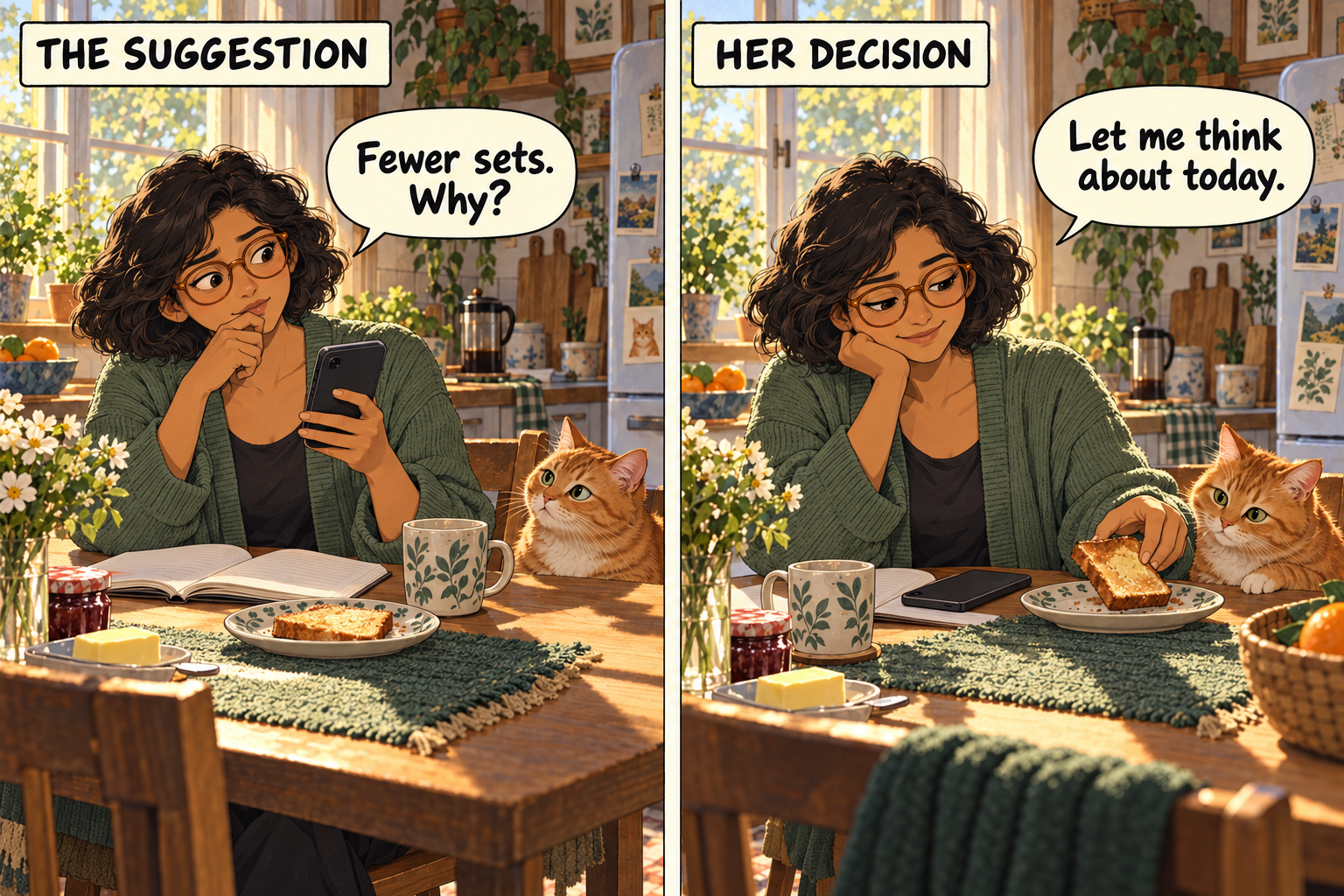
Imagine Maya opening a session that now contains three working sets where there were previously four. The change alone would leave her guessing. An explanation that identifies lower recorded sleep gives her something she can assess.
Musopana’s adjustment interface includes that explanation and a Keep original plan control. Restoring the original should be a clear choice, rather than something a person has to reconstruct by editing the workout.
That control matters because the app has only part of the picture. Maya may recognise that the recorded night was incomplete. She may prefer the original session. Or she may decide that the smaller plan fits how she feels.
None of those decisions makes the measurement irrelevant. They give it an appropriate place in the conversation.
There are limits here. The research discussed above did not test Musopana, and it does not establish that our particular set-reduction rule improves outcomes. That is something we need to evaluate. Availability also depends on the app version and the relevant settings.
What we can make clear now is the intended relationship: the person chooses whether adjustments are enabled, can see the reason for a change, and can restore the original.
The decision belongs to the morning
Maya puts her phone down. Breakfast is getting cold.
The workout is still there. So is the fact that she slept poorly. Neither has to disappear for her to make a considered decision.
Yesterday’s plan was made with yesterday’s information. A useful app should make it easier to reconsider that plan when something changes.
And when it proposes doing less, it should be able to explain itself.
References
- Craven J, McCartney D, Desbrow B, et al. Effects of Acute Sleep Loss on Physical Performance: A Systematic and Meta-Analytical Review. Sports Medicine. 2022;52:2669–2690. Read the paper. ↩
- Chinoy ED, Cuellar JA, Jameson JT, Markwald RR. Performance of Four Commercial Wearable Sleep-Tracking Devices Tested Under Unrestricted Conditions at Home in Healthy Young Adults. Nature and Science of Sleep. 2022. Read the study. ↩
- American Academy of Sleep Medicine. Staying current with actigraphy devices for sleep-wake monitoring. Read the guidance. ↩
- American Academy of Sleep Medicine. Consumer sleep technology is no substitute for medical evaluation. Read the position-statement summary. ↩